Research is an integral part of palliative care
The research focus area ‘Palliative Care: exploration and improvement of care’ (PallCare) examines how care structures function in everyday practice, the quality of care, opportunities for improvement, and the implementation of measures and treatment options. The focus area is led by PD Dr Carsten Klein. The research groups gain insights into care practice from the perspective of patients, relatives and team members. They employ methods from health services research, observational and intervention studies, as well as structured processes in which experts jointly develop recommendations. Some projects translate these findings into recommendations for action, which are then made available to professional care teams, patients and relatives.
The ‘Palliative Care: multimodal analyses of biomarkers’ (PallMAB) focus area, led by Dr Tobias Steigleder, investigates how palliative care can be supported and improved through the integrated analysis of multimodal, i.e. health-related data from various sources. With the aid of modern technologies such as contactless radar systems, wearables (devices worn on the body) and digital systems for data collection and management in healthcare, continuous vital signals (body functions such as heart rate or respiratory rate) are recorded in everyday clinical practice. These are supplemented by biomolecular data (molecular information, e.g. from blood or tissue samples) from a biobank (a collection of biological samples and associated data).
Methods ranging from classical statistical procedures to machine learning and artificial intelligence are used to model complex clinical courses and identify relevant patterns in symptom burden, functional status and disease progression. The aim is to support clinical decision-making processes and enable more precise, data-driven palliative care for people with severe and life-shortening illnesses – for the benefit of patients, their families and care teams.
The research focus ‘Palliative Care: innovations, people and society’ (PallSoc), led by PD Dr Maria Heckel, addresses questions regarding the impact of technological innovations on day-to-day practice in palliative care. Furthermore, the research focus observes and interprets attitudes towards dying, death and bereavement in society and identifies what matters to citizens in terms of care and life at the end of life. It employs participatory research (research in which those affected actively contribute such as Patient and Public Involvement, PPI), observational and intervention studies, interviews, group discussions, and methods for deriving requirements for technological innovations. The findings enable care teams, professional and political decision-makers, and technology developers to make informed, patient-centred and values-guided decisions regarding the use of technological innovations. The voices of patients, relatives and members of the public are made visible and incorporated into the research process. The aim is to critically monitor technological innovations in palliative care, highlight their social and societal implications, and ensure that the development and use of new technologies are consistently aligned with the needs and values of those affected. This focus critically examines which societal and care-related values and assumptions are incorporated into research and development processes.
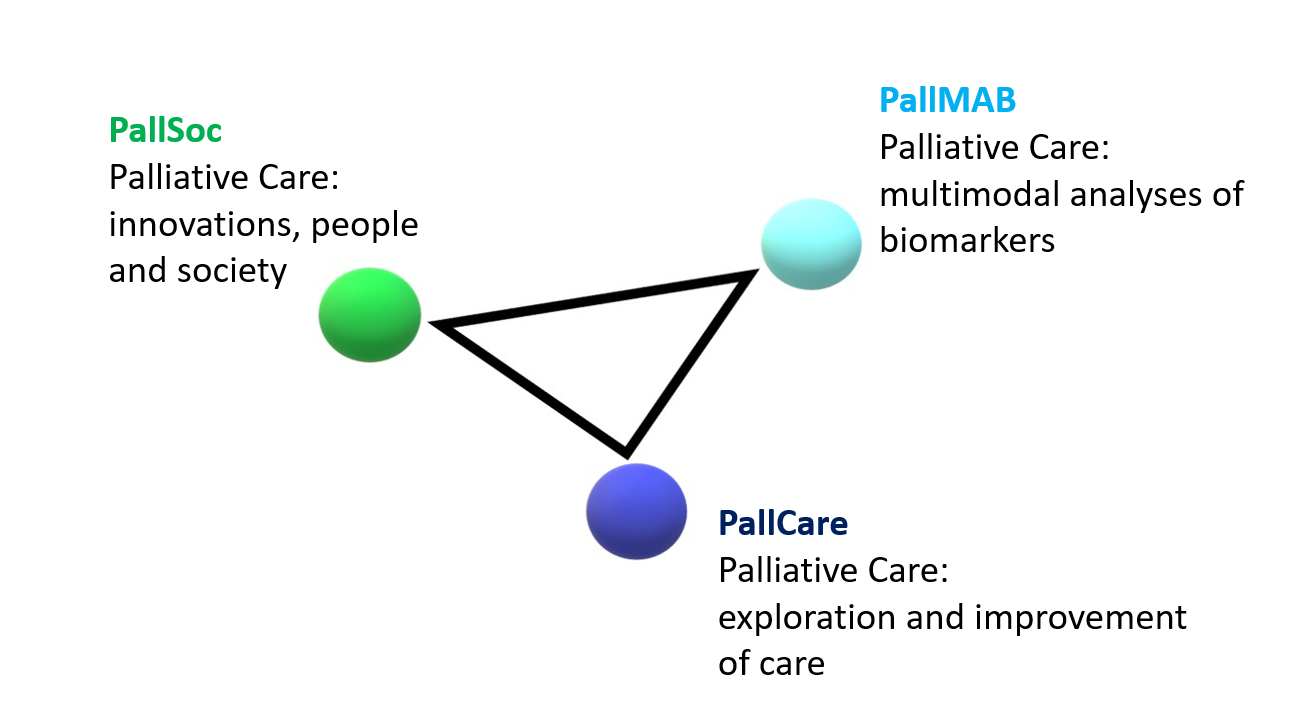
The research priorities that have developed in recent years can be grouped into three thematic Areas:
- clinical-experimental research
- health services research
- education research